

Stop Renting Your AI: AI Agent Costs vs Building Your Own Automation System (2026)
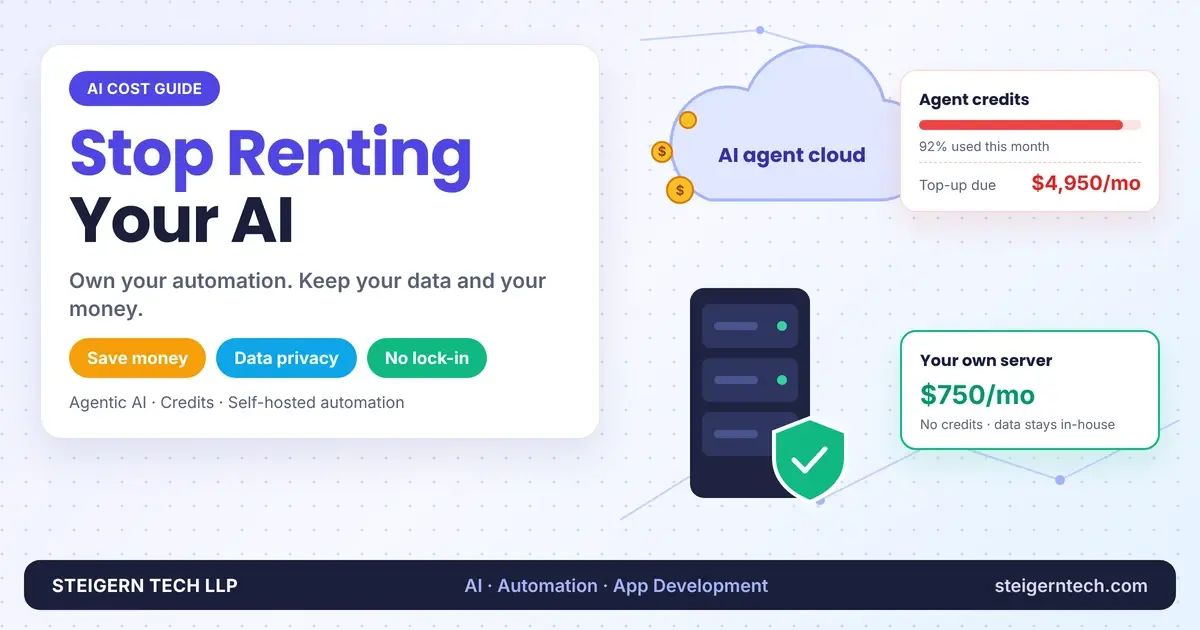
Quick answer: AI agents from vendors charge per conversation, action, resolution or credit, so costs climb as usage grows. For repeatable business work, your own automation system usually pays back within months. It runs rules first and AI only where needed, keeps customer data on your server and removes vendor lock-in.
Key takeaways
- Vendors now bill AI agents per use: $0.99 per resolution on Fin, or $2 per conversation or $0.10 per action on Salesforce Agentforce.
- Reasoning agents use 5 to 30 times more tokens than chatbots, so bills rise even as token prices fall.
- In our worked example of 5,000 resolutions a month, owning costs $35,000 over three years against $178,200 for renting.
- An owned system keeps data on your own server, which makes GDPR and India's DPDP Rules easier to meet.
- Rent for low volume or quick experiments; own for steady, repeatable workflows.
Token prices keep falling, yet AI bills keep rising. Vendors are moving from flat plans to credits, per-action fees and per-resolution charges, and agents burn far more tokens than chatbots. Gartner now calls cost, not capability, the next hurdle for agentic AI.
At Steigern Tech we build automation for businesses in India, Europe and the Pacific. This is what we see coming, and why we tell clients to stop renting and start owning.
What is an AI agent, and what is an owned automation system?
An AI agent is software that uses a large language model to plan steps, call tools and act with little human input. Typical jobs are answering support tickets, qualifying leads or updating CRM records. A rented AI agent runs on a vendor's platform and is billed per use.
An owned AI automation system is workflow software you host yourself. Fixed rules handle routine steps, and an AI model is called only for steps that need judgement. You keep the code, the data and control of the bill.
How much do AI agents cost in 2026?
Every major vendor now bills for usage. You pay per conversation, per action, per resolution, or from a pool of credits. Seat fees often sit on top.
| Vendor | Pricing model | Published rate |
|---|---|---|
| Fin (formerly Intercom) | Per resolution | $0.99 per resolution, plus optional helpdesk seats from $29/month |
| Salesforce Agentforce | Per conversation or Flex Credits | $2.00 per conversation, or $0.10 per action |
| Zendesk AI | Per automated resolution | $1.50 committed, $2.00 pay-as-you-go |
| GitHub Copilot | Token-metered AI Credits | Moved off flat premium requests on 1 June 2026 |
| Cursor | Usage allowance tied to API cost | Replaced 500 fast requests a month in June 2025 |
The pattern is clear. Flat plans are disappearing, and the bill now rises with every task an agent runs. When the credits run out, the work stops or you buy more.
Why do AI agent bills keep rising when token prices fall?
Agents loop. They plan, call tools, check results and retry, resending the whole context at each step. Gartner says reasoning agents use 5 to 30 times more tokens than chatbots, and expects inference cost per agentic workflow to rise more than fivefold through 2028.
That is why falling token prices do not help. Blended token prices fell about 67% from Q1 2025 to Q1 2026, yet 73% of enterprises said their AI costs beat projections (Rework). Gartner also predicts over 40% of agentic AI projects will be canceled by the end of 2027, with escalating costs a leading cause.
A worked example. A business handles 5,000 AI-resolved support conversations a month. We compare a rented agent with a system it owns:
- Rented agent: 5,000 × $0.99 per resolution = $4,950 a month, at Fin's published rate.
- Own system: a one-time build of $8,000, then $750 a month for model usage, hosting and upkeep (our illustrative estimate).
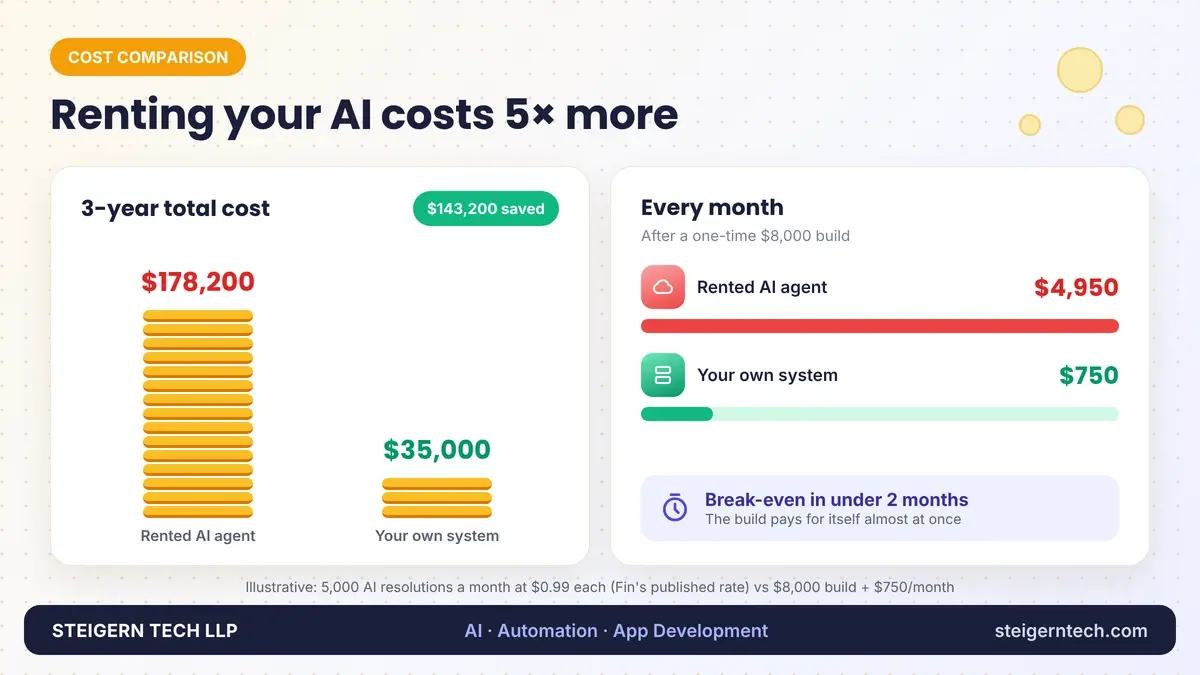
The own system pays back its build in under two months. This example even assumes vendor prices stay flat, while Gartner expects agent costs to climb.
Is your data safe with a rented AI agent?
A rented agent works by sending your customer records, emails, invoices and code to someone else's servers. Each prompt carries context, and agents resend that context at every step. Your most sensitive data travels most often.
Ungoverned AI is already expensive. IBM's 2025 Cost of a Data Breach report found one in five organisations had a breach linked to shadow AI. Those breaches cost $670,000 more on average and exposed more personal data.
The rules are tightening too:
- India: The DPDP Rules 2025 were notified in November 2025. Penalties reach ₹250 crore for failing to keep reasonable security safeguards, and most obligations apply from May 2027.
- Europe: GDPR governs every customer record a vendor processes for you, including where it is stored and who can see it.
- Client contracts: Many NDAs forbid sharing client data with third-party AI services at all.
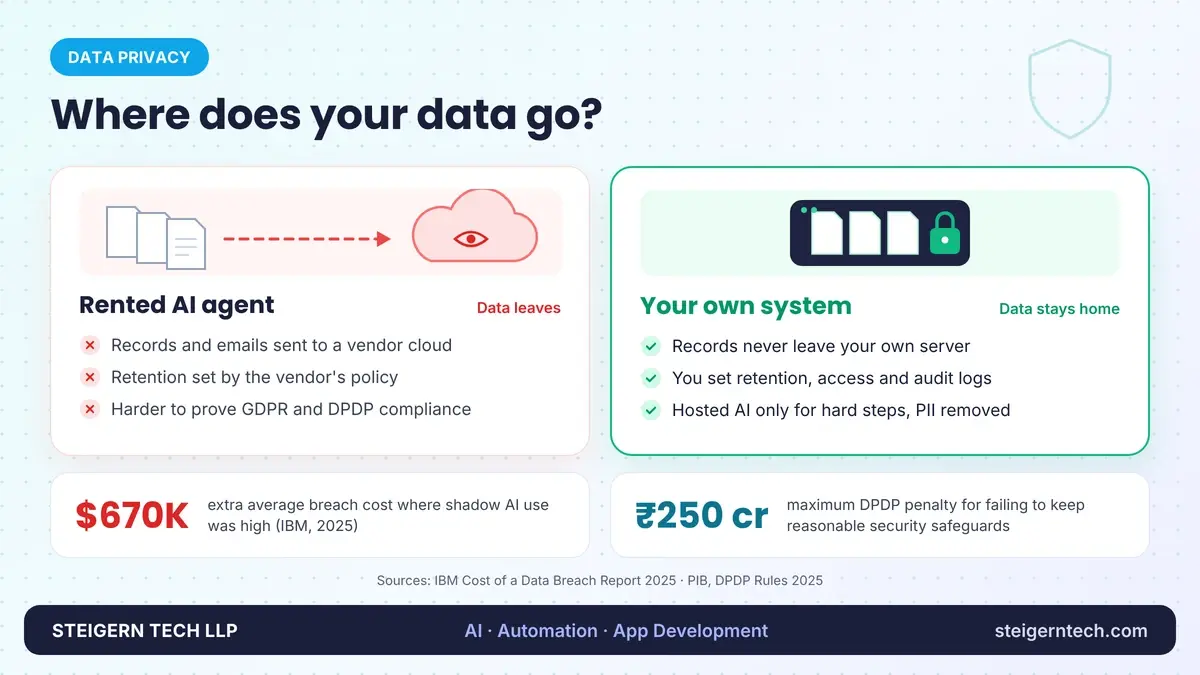
When the system runs on your own server, the data stays there. You decide what is logged, what is kept and what, if anything, leaves.
What is AI vendor lock-in, and why does it matter?
When you rent, the vendor sets the price, the limits and the roadmap. In 2026 alone, GitHub raised the multiplier for its top model tier from 7.5x to 27x in three months. Other providers added weekly limits and peak-hour throttling (Speakeasy).
Ownership changes too. Salesforce agreed to buy Fin, the company behind the Fin agent, in June 2026 (Tech Insider). Customers of an acquired tool cannot know what its pricing will look like next year.
The deepest cost is what you never get back:
- Your workflows live in the vendor's builder and rarely export cleanly.
- Your prompts and tuning stop working the day you leave.
- Your uptime depends on their outages and their rate limits.
A system you own is code in your repository. You can move it to another server, swap in a different model or hand it to a new team.
What does your own AI automation system look like?
Most business work is not open-ended. Reading an invoice, updating Odoo, answering a known question or routing a lead follows rules. Only a few steps need real AI judgement.
An owned system uses that fact. Fixed rules run for almost nothing, and a router sends only judgement steps to a model. Anthropic's engineers cut one agent workflow from 150,000 tokens to 2,000 just by keeping tool definitions and intermediate results out of the model (Speakeasy).
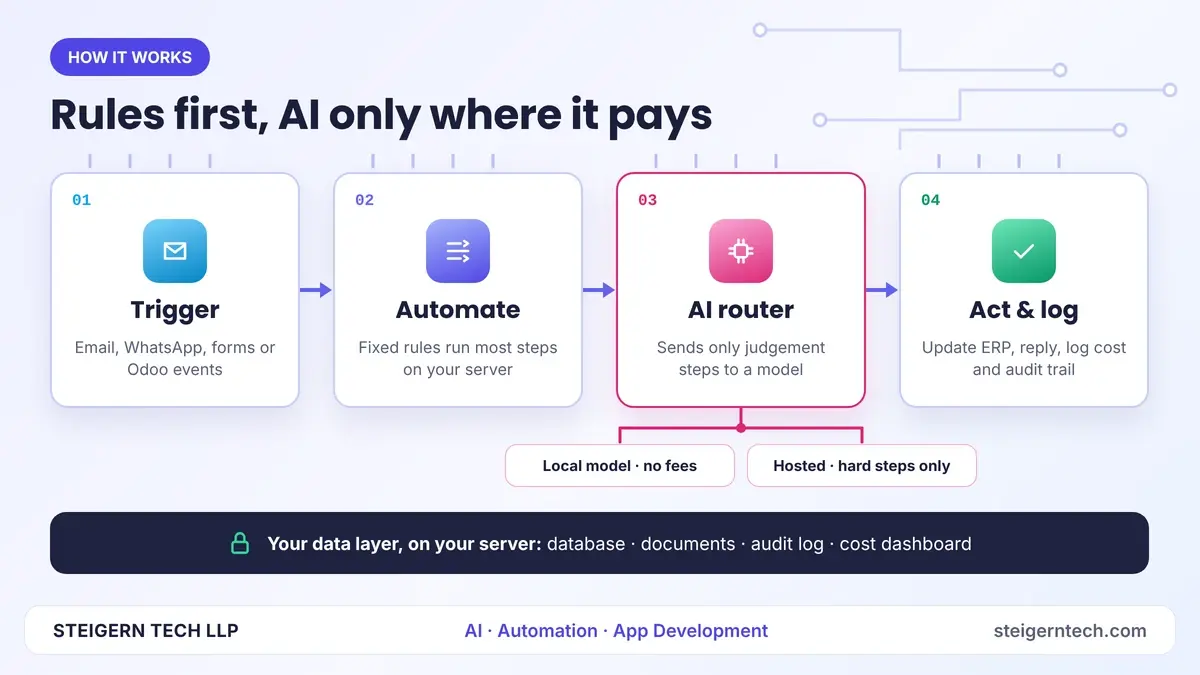
Everything above the data layer can be replaced part by part, so a cheaper or better model never means a rebuild.
Not sure which AI pattern fits your workflow? Our guide to RAG vs MCP vs AI agents compares them. Our Odoo workflow automation builder shows rules-first automation inside Odoo, and our cloud infrastructure and DevOps team handles self-hosting.
Rented AI agent vs your own automation system: side-by-side
For steady, repeatable work, an owned system wins on cost, privacy and control; a rented agent wins only on speed to start.
| Factor | Rented AI agent | Your own automation system |
|---|---|---|
| Pricing | Per conversation, action, resolution or credit | One-time build, then hosting and model usage |
| Cost as volume grows | Rises with every task | Mostly flat; rule-based steps cost almost nothing |
| Where data lives | Vendor's cloud | Your server or private cloud |
| GDPR and DPDP control | Depends on the vendor's policy | You set retention, access and logs |
| Lock-in | High: workflows live in the vendor's builder | Low: code sits in your own repository |
| Time to start | Days | Weeks |
| Best for | Low volume, testing an idea | Steady, repeatable workflows |
When should you still rent an AI agent?
Owning is not always the right call. Rent when:
- Volume is low. A few hundred tasks a month rarely justify a build.
- You are still testing the idea. A rented tool proves demand before you invest.
- The task is truly open-ended. Frontier research or one-off creative work benefits from the largest hosted models.
The best setup is often hybrid. You own the workflows, the data and the routing, and call a hosted model only for the hard steps. You can switch that model whenever a cheaper or better one appears.
How does Steigern Tech build your own AI automation system?
We start with your most expensive workflow and replace it first. Savings from that one build often pay for the next.
- Audit your AI spend. We list every subscription, credit pack and per-task fee, and find the workflows that cost the most.
- Map the workflow. We separate the steps that follow fixed rules from the few that need AI judgement.
- Build and self-host. We deploy the orchestrator, database and model on your server or private cloud.
- Route and cache. Simple steps go to small or local models, and repeated answers are reused instead of paid for again.
- Hand over the code. You get the repository, documentation and a cost dashboard, so nothing is locked in.
We have built this kind of system for ERP, Odoo, POS and media-monitoring clients. See our AI agent development, workflow and business automation and Odoo ERP services, or test an idea first in our Rapid PoC Lab. Small fixed-price projects start from 329 EUR, and hourly work from 16 EUR (how we engage).
Ready to stop buying credits? Email [email protected], WhatsApp +91 94275 72571, or visit steigerntech.com to talk through your AI spend.
Frequently asked questions
How much does an AI agent cost per month?
It depends on volume and the pricing model. At Fin's published $0.99 per resolution, 5,000 resolutions a month cost about $4,950. Per-conversation pricing, such as Agentforce's $2, charges for every conversation, resolved or not. Seats, overages and setup come on top.
How do I calculate the cost of an AI agent?
Multiply your monthly volume by the vendor's unit price, then add seats, overages and setup. For an owned system, add the one-time build to monthly hosting, model usage and upkeep. Break-even month = build cost ÷ (rented monthly cost − owned monthly cost).
What is the difference between an AI agent and workflow automation?
Workflow automation follows fixed rules you define, so it is cheap and predictable. An AI agent uses a language model to choose its steps, which handles messy tasks but costs more per run. The best systems use rules for most steps and an agent only where judgement is needed.
Is building my own AI automation system expensive?
The build is a one-time cost, usually smaller than one year of per-task fees at medium volume. After that you pay only for hosting, model usage and upkeep.
Do I need my own GPU server?
Not always. Many workflows run on small open-weight models on a standard cloud server. Others call a hosted model only for the hard steps, with personal data removed first.
Will my own system be as good as a commercial AI agent?
For repeatable business tasks, usually yes, because it is built around your data and rules. For open-ended research, a hosted frontier model may still be better, and a hybrid setup can call it.
How does owning the system help with GDPR and DPDP compliance?
Your data stays on infrastructure you control. You set retention, access and logging yourself instead of relying on a vendor's policy.
What happens if a better AI model is released?
You swap the model in your router. Your workflows, data and integrations stay as they are.
How much does it cost to have Steigern Tech build my own AI automation system?
Small fixed-price projects start from 329 EUR, and hourly work from 16 EUR. A full build depends on how many workflows and integrations you need. We scope it after reviewing your current AI spend.
Sources
- Gartner: Agentic AI's next hurdle is cost, not capability (26 October 2026)
- Gartner: Over 40% of agentic AI projects will be canceled by end of 2027
- Speakeasy: The rising price of AI
- Fin: AI customer service agent pricing comparison 2026
- Fin: AI customer service pricing models compared
- Tech Insider: Fin vs Zendesk AI vs Agentforce 2026
- IBM: Cost of a Data Breach 2025 press release
- PIB: DPDP Rules 2025 notified
- Rework: Token prices fell 67%, your AI bill is going up anyway
Related Engineering Insights
RAG vs MCP vs AI Agents: Which Is Best to Automate Your Business?
No single one is 'best'. RAG makes AI know your business, MCP connects AI to your software, and AI Agents let AI do the work. The businesses getting real results use them together, in that order.
AI Odoo Dashboard: Build Smart Odoo Dashboards with AI
Build live Odoo dashboards with AI: 17 chart types, KPI tiles, one-click chart insights and offline AI. Cosmic Dashboard by Steigern Tech on Odoo Apps.
IoT and AI in Agriculture: How Smart Farming Helps Farmers Grow More
Learn how IoT sensors and AI help farmers save water, cut costs and grow better crops, with real data, 8 use cases and a Contra Farms case study.
Ready to engineer your system with production discipline? Talk to our lead architects.
Our senior engineers review your requirements, design the technical roadmap, and deploy dedicated squads tailored to your tech stack.