

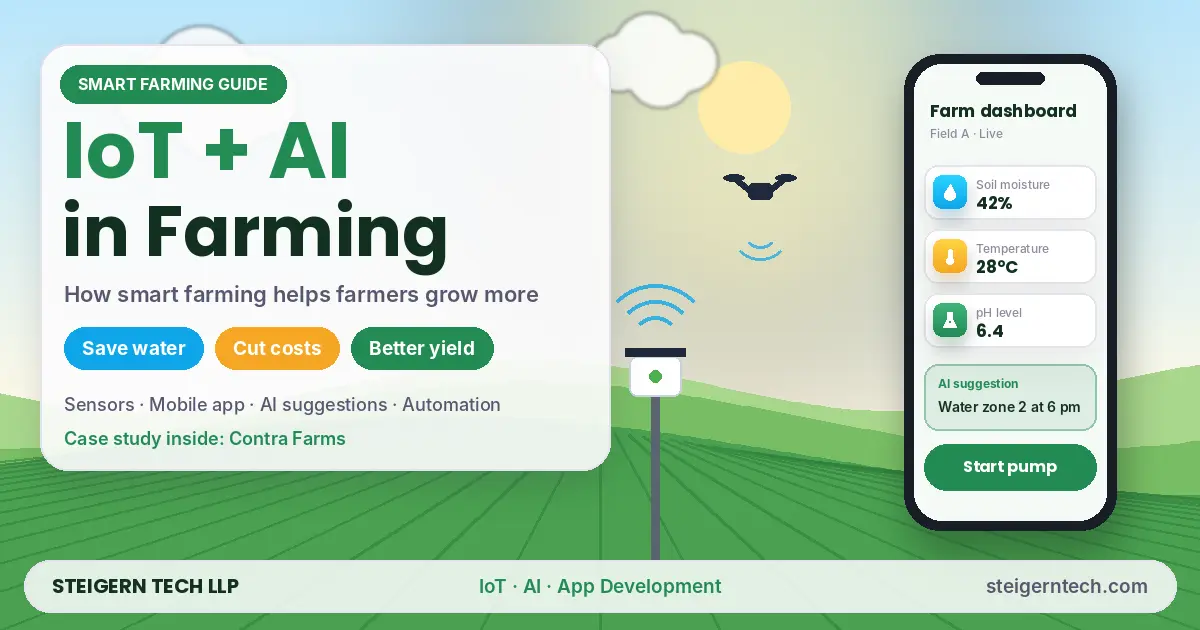
IoT and AI in Agriculture: How Smart Farming Helps Farmers Grow More
Quick answer
IoT and AI help farming by measuring what crops need in real time and acting on it automatically. IoT sensors track soil moisture, temperature, humidity, pH and nutrients, and send that data to the cloud. AI analyses it to predict water needs, spot disease early and recommend the next action. Together they let farmers use less water, fertiliser and labour while growing healthier, more consistent crops.
Key takeaways
- IoT = the farm's senses. Sensors and connected machines collect live data from fields, greenhouses and grow chambers.
- AI = the farm's brain. It turns that data into predictions, alerts and simple recommendations.
- Proven savings. A 2024 field study found sensor-based irrigation used 30% less water with no loss in yield (Frontiers in Water).
- Fast-growing market. AI in agriculture is projected to grow from USD 2.8 billion in 2025 to USD 8.5 billion by 2030 (BCC Research).
- Real example. Steigern Tech built the Contra Farms IoT farming app, which lets growers monitor and control indoor grow chambers from their phone, with AI suggestions.
What is smart farming?
Smart farming (also called precision agriculture or Agriculture 4.0) is the use of connected sensors, data and artificial intelligence to manage crops and livestock more precisely. Instead of watering, feeding or spraying on a fixed schedule, farmers act on live data about what each field, greenhouse or plant actually needs.
Businesses that want to put smart farming into practice usually start with AgriTech software development: field sensors, a farm app and a cloud dashboard built around their own crops and workflows.
What is IoT in agriculture? The Internet of Things (IoT) in agriculture means physical devices on the farm, such as soil sensors, weather stations, water meters, cameras, pumps and lights, that are connected to the internet. They collect data continuously and can be switched on or off remotely.
What is AI in agriculture? Artificial intelligence in agriculture means software that learns from farm data to make predictions and decisions: when to irrigate, which plants show early signs of disease, what yield to expect, or which nutrient mix to dose.
Water is the clearest reason this matters. Around 70% of the world's freshwater is used for agriculture (World Bank), and India withdraws more water for agriculture than any other country (Down To Earth). Using that water precisely is one of the biggest wins smart farming offers.
How IoT and AI work together on a farm
A smart farming system runs as a loop: sense, connect, analyse, act.
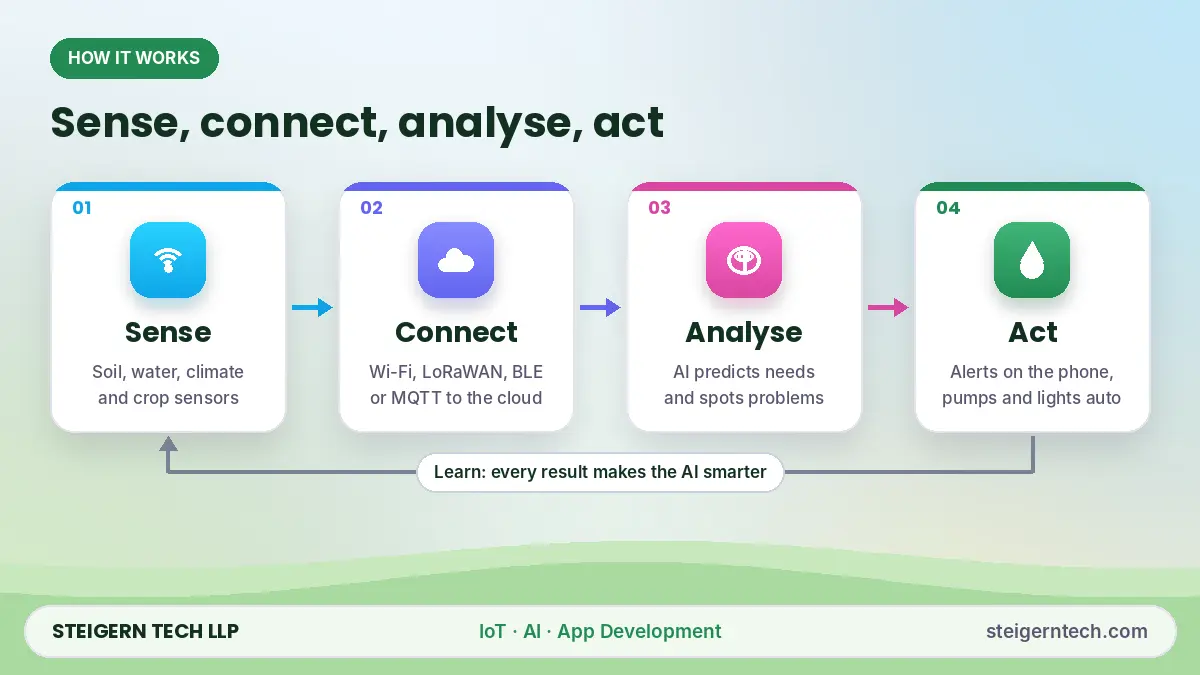
- Sense: IoT sensors measure soil moisture, temperature, humidity, light, pH, nutrients (TDS) and water levels in the field, greenhouse or grow chamber.
- Connect: a gateway or the device itself sends readings over Wi-Fi, mobile data, LoRaWAN or Bluetooth to a cloud platform, often using a lightweight protocol such as MQTT.
- Analyse: AI models compare the readings with crop needs, weather forecasts and past data to predict problems and pick the best action.
- Act: the system sends an alert to the farmer's phone, or controls equipment directly: it starts a pump, doses nutrients, switches lights or turns on fans.
- Learn: every result is stored, so the AI's recommendations improve over time.
The farmer stays in control through a mobile app and dashboard, where they see live data, get alerts and approve or override actions.
This is the same architecture behind modern precision farming software, from LoRaWAN soil moisture and weather station gateways to closed-loop smart irrigation controllers.
8 ways IoT and AI help farmers
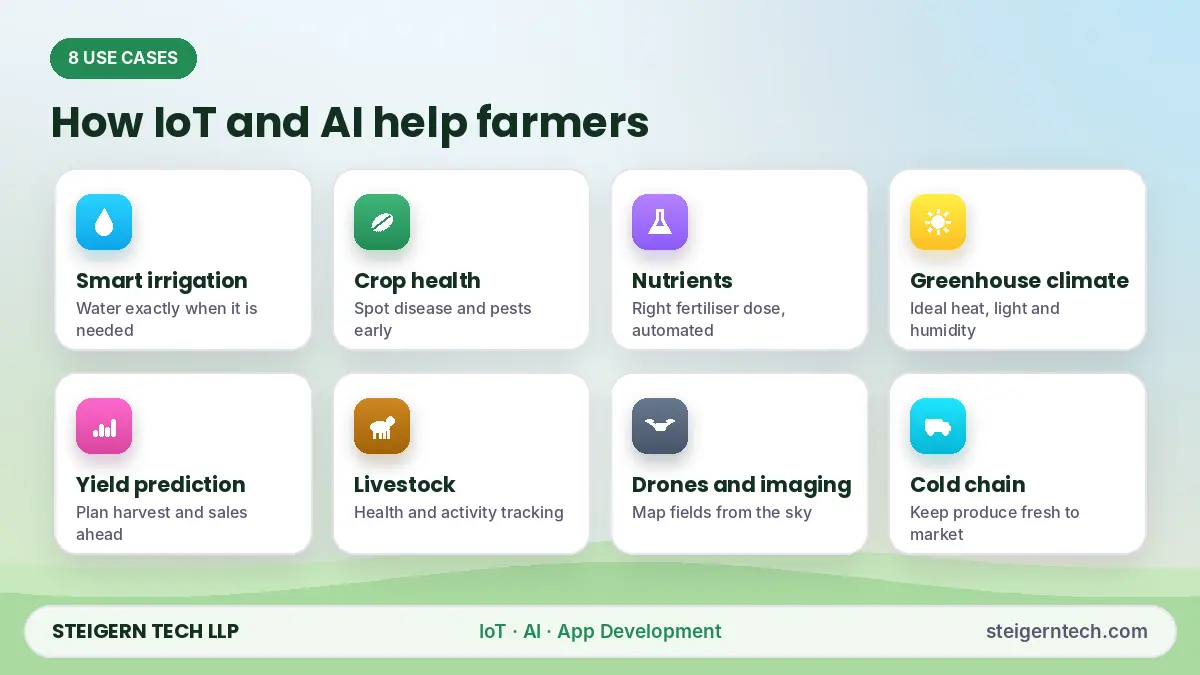
| Use case | What IoT does | What AI adds |
|---|---|---|
| Smart irrigation | Soil moisture sensors and remote pump control | Predicts when and how much to water using weather and soil data |
| Crop health monitoring | Cameras, drones and leaf sensors capture images | Detects disease, pests and nutrient deficiency early |
| Nutrient management | pH and TDS sensors track soil or water nutrients | Recommends and automates the right fertiliser dose |
| Climate control in greenhouses | Temperature, humidity and light sensors with fans, misters and LEDs | Keeps ideal conditions automatically for each crop stage |
| Yield prediction | Long-term field and growth data | Forecasts harvest size and timing for better planning and sales |
| Livestock monitoring | Wearable tags track movement, temperature and feeding | Flags illness or heat cycles before they are visible |
| Equipment and energy | Smart meters and machine sensors | Predicts maintenance and schedules pumps to save power |
| Supply chain and storage | Cold-storage and transport sensors | Predicts spoilage and plans the fastest route to market |
Many of these use cases are available as ready-to-customise modules, including drone NDVI crop mapping, livestock telemetry and farm-to-fork traceability. See our IoT agriculture solutions.
Benefits of IoT and AI in farming
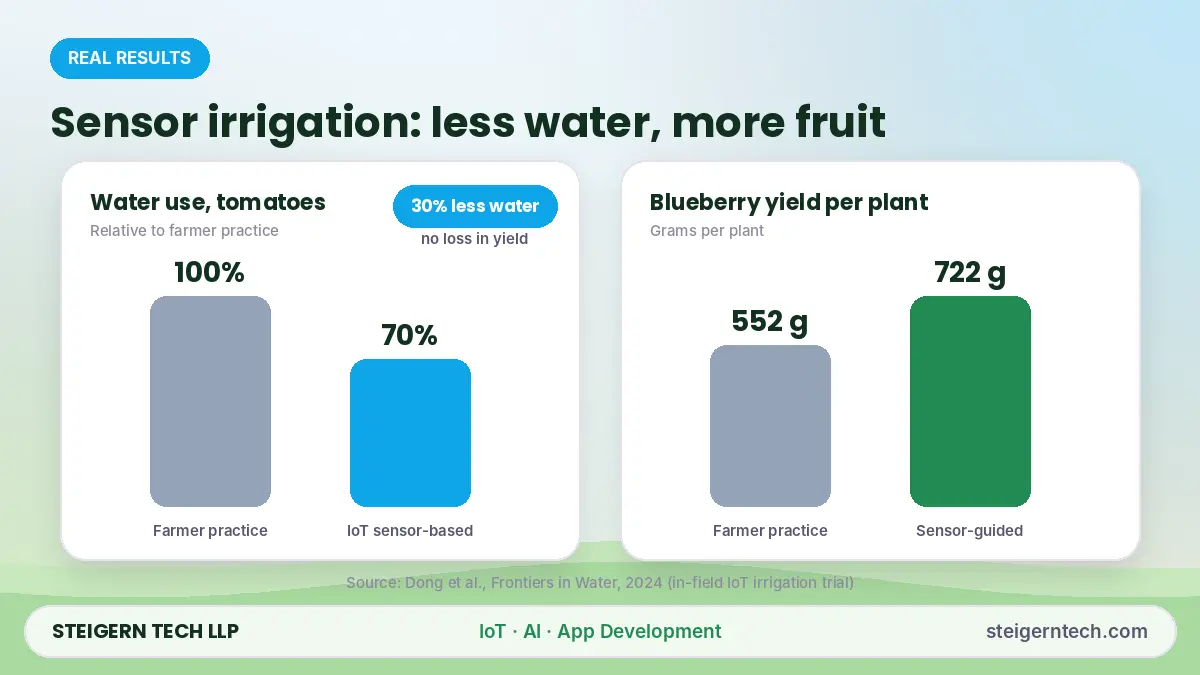
- Less water, same yield. In a 2024 field trial on tomato and blueberry farms, an in-field IoT irrigation system applied 30% less water on tomatoes with no significant yield difference, and blueberry yield per plant rose from 552 g to 722 g under sensor-guided management (Frontiers in Water, 2024).
- Lower input costs. Applying water, fertiliser and pesticide only where and when needed cuts waste and spending.
- Earlier problem detection. Alerts for pH drift, dry soil, heat stress or disease arrive before crop damage becomes visible.
- Less manual work. Remote control and automation replace daily field checks and manual switching of pumps and lights.
- More consistent quality. Stable conditions produce more uniform crops, which matters for buyers, cafés and retailers.
- Better decisions. Historical data and AI forecasts help plan planting, harvest and sales.
- Sustainability. Less water and chemical use reduces environmental impact, an increasing requirement for exporters and large buyers.
Investment is following these results: the global AI in agriculture market is projected to reach USD 8.5 billion by 2030, growing 25.1% a year from 2025 (BCC Research, 2026).
To see how these benefits become real products, from smart irrigation systems to farm management software and multi-field accounting, visit our agriculture page.
Case study: Contra Farms IoT farming app by Steigern Tech
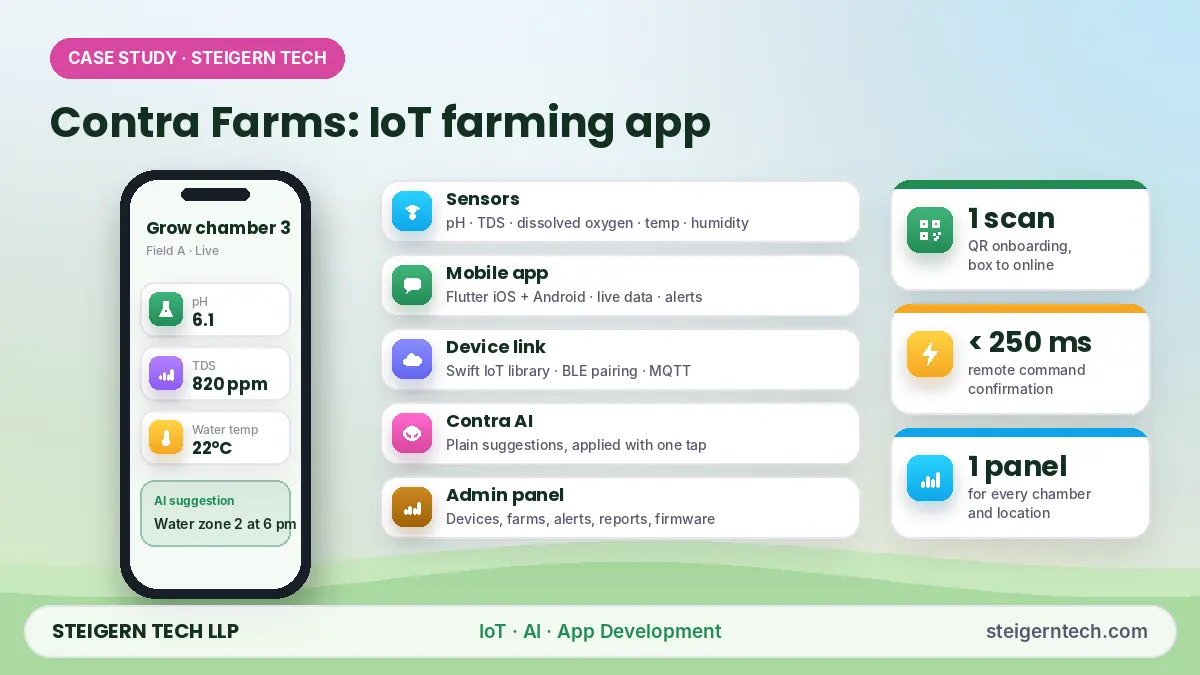
Contra Farms builds indoor grow chambers used in homes, cafés, schools and commercial farms. Steigern Tech designed and built the connected system that turns each chamber into a smart, remotely managed farm.
The problem
- Sensor readings stayed inside the chamber, so growers couldn't see pH drift or lights left on.
- Changing settings meant standing next to the machine.
- Contra Farms had no single view of all chambers across locations.
What we built
| Layer | What it does |
|---|---|
| Sensors | pH, TDS (nutrients), dissolved oxygen, water and air temperature, humidity |
| Actuators | LED shelf lights, water pump and nutrient dosing, fan and misting |
| Mobile app | Flutter app for iOS and Android: live readings, out-of-range alerts, remote control |
| Device link | Native iOS IoT library in Swift, BLE pairing, MQTT messaging |
| Onboarding | "1-Scan" QR activation: a new chamber goes from box to online with one scan |
| Contra AI | Plain-language growing suggestions that growers apply with one tap |
| Admin panel | Manage devices, farms, alerts, reports and firmware updates in one place |
The result
Growers now see every chamber live on their phone and control lights, pumps, dosing and fans from anywhere. Each remote command is confirmed back in the app in under 250 ms, setup takes a single QR scan, and Contra Farms manages all its chambers from one admin panel.
→ See the full Contra Farms project
Challenges of smart farming, and how to solve them
| Challenge | Practical solution |
|---|---|
| High upfront cost | Start with one field, greenhouse or chamber, prove savings, then scale |
| Poor internet in rural areas | Use LoRaWAN or offline-first devices that sync when a connection is available |
| Data overload | Show farmers simple alerts and one-tap actions, not raw charts |
| Low digital skills | Mobile apps in local languages with voice and clear icons |
| Sensor maintenance | Choose rugged sensors, schedule calibration and track device health in an admin panel |
| Different hardware brands | Use open protocols such as MQTT so devices and apps work together |
| Data security | Encrypted connections, role-based access and secure firmware updates |
How to start with smart farming: 6 steps
- Pick one problem to solve. For example, water use in one field, temperature in one greenhouse, or nutrient levels in a hydroponic system.
- Choose the right sensors. Match sensors to that problem: soil moisture and weather for irrigation, pH and TDS for hydroponics, temperature and humidity for greenhouses.
- Connect them. Decide on Wi-Fi, mobile data, LoRaWAN or Bluetooth based on your site, and send data to a secure cloud platform.
- Build a simple app and dashboard. Farmers need live readings, clear alerts and remote control on their phone; managers need an admin view across sites.
- Add automation and AI. Start with rule-based automation ("start the pump when soil moisture drops below X"), then add AI predictions and recommendations as data builds up.
- Measure and scale. Compare water, fertiliser, labour and yield before and after, then roll out to more fields or locations.
Need help with steps 2 to 5? Our smart farming app development team handles sensor integration, mobile apps, dashboards and AI.
Frequently asked questions
How does IoT help in farming?
IoT helps farming by connecting sensors and equipment to the internet. Farmers get live data on soil, water, climate and crops on their phone, receive alerts when something goes wrong, and can control pumps, lights and fans remotely.
How is AI used in agriculture?
AI is used to predict irrigation needs, detect plant disease and pests from images, recommend fertiliser doses, forecast yields and automate greenhouse climate control.
What is the difference between IoT and AI in farming?
IoT collects data and controls devices; AI analyses that data and decides what to do. IoT is the farm's senses and hands, AI is its brain.
How much water can smart irrigation save?
Results vary by crop and region. In one 2024 field study, sensor-based irrigation used 30% less water on tomatoes without reducing yield.
Is smart farming only for large farms?
No. Small farms, greenhouses, hydroponic setups and even indoor grow chambers in homes, cafés and schools can use IoT and AI, starting with a few sensors and a mobile app.
What sensors are used in smart farming?
Common sensors measure soil moisture, temperature, humidity, light, pH, TDS (nutrients), dissolved oxygen, rainfall and water level.
What technology is used to build a smart farming app?
A typical stack includes IoT sensors and controllers, a connectivity protocol such as MQTT, BLE or LoRaWAN, a cloud API and database, a cross-platform mobile app (for example Flutter), an admin panel and AI models for recommendations.
Can Steigern Tech build a custom IoT farming app?
Yes. Steigern Tech builds custom IoT and AI agriculture solutions, including mobile apps, device integration, cloud platforms, admin panels and AI features, as shown in the Contra Farms project.
Who builds smart farming and agritech apps in India?
Steigern Tech LLP, based in Ahmedabad, is an agriculture app development company that builds IoT farming apps, precision agriculture software, farm ERP and AI crop tools for agribusinesses, co-ops and agri-tech startups.
Build your smart farming solution with Steigern Tech
Whether you make farm equipment, run greenhouses or hydroponic farms, or want to launch an agri-tech product, Steigern Tech LLP can build the full system: IoT device integration, mobile apps for iOS and Android, cloud platform, admin dashboard and AI features.
See what we built for Contra Farms, then tell us about your project.
Explore everything we build for farming on our AgriTech & Smart Farming App Development page.
- WhatsApp: +91 94275 72571
- Email: [email protected]
- Website: steigerntech.com
- Office: 312, Arista Business Space, Sindhu Bhavan Marg, Bodakdev, Ahmedabad, Gujarat 380059
Related Engineering Insights
RAG vs MCP vs AI Agents: Which Is Best to Automate Your Business?
No single one is 'best'. RAG makes AI know your business, MCP connects AI to your software, and AI Agents let AI do the work. The businesses getting real results use them together, in that order.
Odoo Workflow Automation: an n8n-Style Visual Workflow Builder Inside Odoo
Automate Odoo with a drag-and-drop, n8n-style workflow builder: triggers, If/Else, approvals, emails, webhooks and logs. By Steigern Tech LLP on Odoo Apps.
Xero Odoo Connector: Sync Odoo with Xero via the Xero REST API
Sync Odoo with Xero using the Xero REST API. Contacts, products, invoices, bills and payments for Odoo 16–19. By Steigern Tech LLP, on Odoo Apps.
Ready to engineer your system with production discipline? Talk to our lead architects.
Our senior engineers review your requirements, design the technical roadmap, and deploy dedicated squads tailored to your tech stack.