
Beyond the Vibe code: AI Generated code needs professional development to scale


In the modern era of software development, a new term has entered the lexicon: Vibe Coding. Powered by LLMs and rapid-prototyping AI, it allows founders to “vibe” a product into existence describing a feature and watching the code appear.
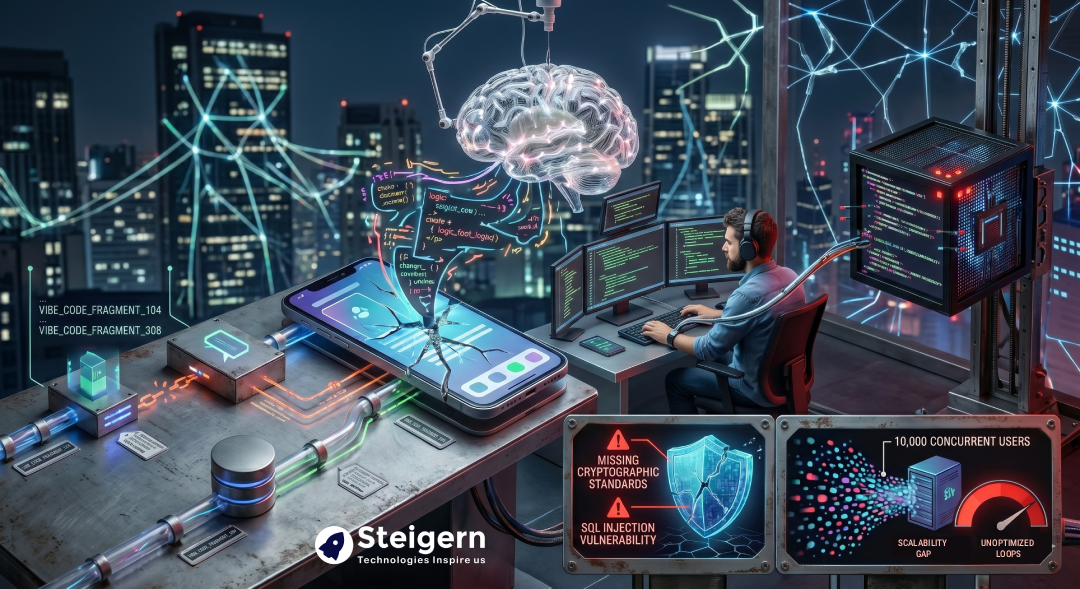
However, there is a looming crisis of craftsmanship. While AI can generate a “vibe,” it cannot maintain a distributed system. It can build a UI, but it cannot secure a voter database or handle the low-latency requirements of a voice-activated AI agent. This is where the gap between a “prototype” and a “product” widens.
For clients, this gap manifests as “Vibe Coding issues” bugs that feel ephemeral, features that look right but don’t work, and architectural debt that accumulates before the first user even signs up. This is where the synergy between visionary clients and seasoned developers becomes the ultimate competitive advantage.
What is Vibe Coding?
Vibe Coding is the practice of using generative AI tools (like LLMs and automated app builders) to manifest software through intent rather than manual syntax. It’s about describing a “feeling,” a “flow,” or a “vibe” and letting AI generate the underlying codebase.
While this has democratized creation, it has also introduced a unique set of challenges:
-
Context Fragmentation: AI often loses the “thread” of a large project, leading to code that works in isolation but fails in integration.
-
The “Black Box” Bug: When a developer doesn’t write the code, they might not understand why it fails, making debugging a nightmare.
-
Security and Scalability Gaps: AI prioritises the “happy path”, the version where everything works, often ignoring edge cases, cryptographic security, and high-load performance.
Fixing the “Vibe”: How Expert Developers Save the Day
When a client brings a project born from Vibe Coding to a professional team, the goal isn’t to start over. It’s to harden the vision. Here is how developers are helping clients navigate this new era:
1. Technical Auditing & Refactoring
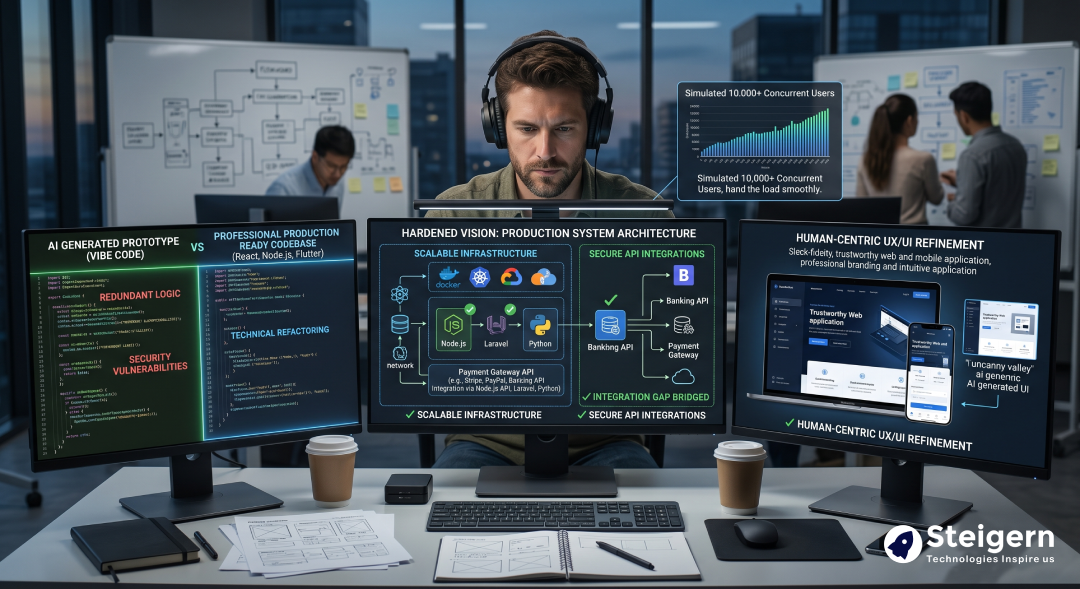
The first step is moving from “it looks like it works” to “it is verified.” Developers dive into the AI-generated blocks to identify redundant logic and security vulnerabilities. This involves refactoring messy, auto-generated scripts into clean, modular codebases using frameworks like React, Node.js, or Flutter.
2. Bridging the Integration Gap
Vibe Coding is great at building “islands” of functionality. A developer’s job is to build the bridges. Whether it’s connecting a sleek frontend to a complex distributed system or ensuring a payment module (like using node api, laravel, react.js, python or odoo integrations) talks correctly to a banking API, human expertise ensures the ecosystem is cohesive.
3. Scaling the Sentiment
AI can build a landing page, but can it handle 10,000 concurrent users? Expert developers implement professional-grade infrastructure using tools like Docker, Kubernetes, and optimized cloud architectures to ensure that the “vibe” doesn’t crash when the business goes viral.
4. Human-Centric UX/UI Refinement
AI often produces “uncanny valley” interfaces they are technically correct but feel slightly off. Professional developers and designers polish these realistic human depictions and brand identities to ensure the user experience feels premium, trustworthy, and original.
Why “Vibe Coding” Fails at Scale
Vibe coding is excellent for the 0-to-1 phase, but it often hits a “logic ceiling.”
1.1 The Technical Debt Trap
AI-generated code is often “stateless.” It solves the immediate prompt without understanding the 10,000 lines of code that came before it. This leads to:
-
Dependency Hell: Conflicting libraries that break on deployment.
-
Performance Bottlenecks: Unoptimized loops and redundant API calls.
-
Security Vulnerabilities: Lack of proper sanitisation and cryptographic standards.
1.2 The Illusion of Functionality
A “vibe-coded” app might look perfect in a demo but crumble under 1,000 concurrent users. Professional engineering is the process of building for the “unhappy path” ensuring that when things go wrong, the system fails gracefully rather than catastrophically.
Case Study TalkXAI (The Evolution of Conversational AI)
Domain: AI Calling Agents for Business Support, Sales, and Marketing
URL: talkxai.com
The Challenge
TalkXAI represents the cutting edge of sales automation. The goal was to create AI calling agents that don’t just follow a script, but engage in fluid, human-like dialogue to handle support and marketing.
The Steigern Tech Solution
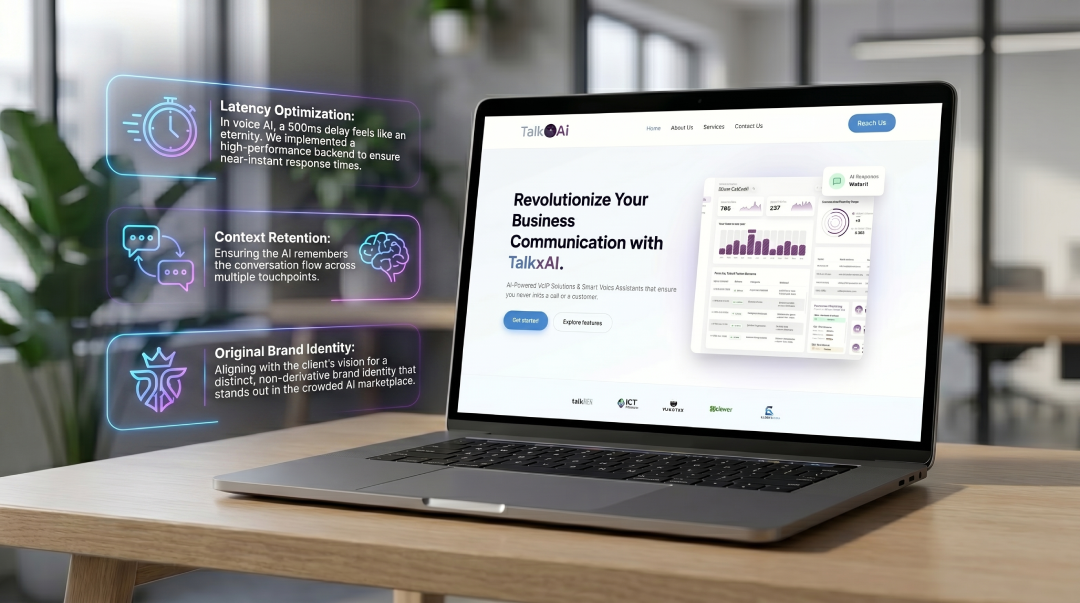
Building an AI agent requires more than just an API call to an LLM. We focused on:
-
Latency Optimization: In voice AI, a 500ms delay feels like an eternity. We implemented a high-performance backend to ensure near-instant response times.
-
Context Retention: Ensuring the AI remembers the conversation flow across multiple touchpoints.
-
Original Brand Identity: Aligning with the client’s vision for a distinct, non-derivative brand identity that stands out in the crowded AI marketplace.
The Result
TalkXAI has moved from a conceptual “agent” to a robust business tool capable of handling thousands of automated sales calls, providing businesses with a 24/7 digital workforce that scales infinitely.
Case Study: Auramind (Tech for Human Connection)
Domain: Personal Space for Emotional Wellness and Healing
URL: auramind.space
The Challenge
Mental health and emotional wellness platforms require a level of “soft” engineering. The tech must be invisible, providing a safe, calming, and ultra-secure environment for users to explore their healing journey.
The Steigern Tech Solution
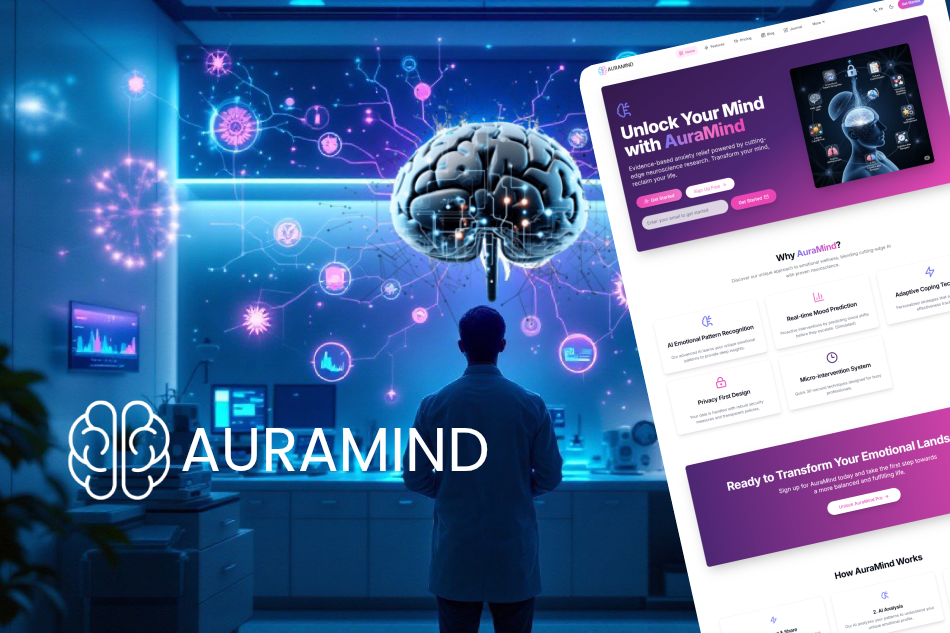
For Auramind, the “vibe” was peace. The engineering reality was complex:
-
Privacy-First Architecture: Implementing end-to-end encryption for personal reflections and wellness data.
-
Realistic Visual Language: Moving away from sterile, “cartoony” corporate art toward realistic human depictions that foster genuine emotional resonance.
-
Seamless Cross-Platform Experience: Ensuring the “healing space” is accessible on both mobile and web without friction.
The Result
Auramind serves as a digital sanctuary, proving that high-end technical architecture can be used to facilitate deeply human experiences.
Case Study: CCRET (Data Integrity in Governance)
Domain: Voters Records Store and Analysis
URL: ccret.net
The Challenge
When dealing with national voter records, the margin for error is zero. CCRET required a platform that could store, analyze, and visualize complex political data with absolute integrity and transparency.
The Steigern Tech Solution
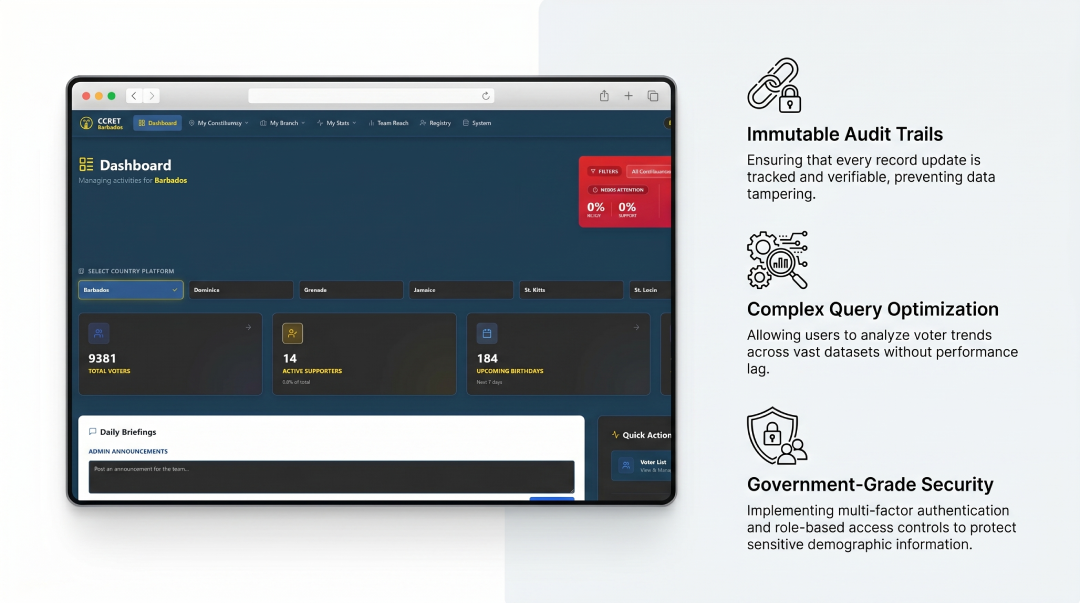
This project demanded our expertise in Distributed Systems and Data Analysis:
-
Immutable Audit Trails: Ensuring that every record update is tracked and verifiable, preventing data tampering.
-
Complex Query Optimization: Allowing users to analyze voter trends across vast datasets without performance lag.
-
Government-Grade Security: Implementing multi-factor authentication and role-based access controls to protect sensitive demographic information.
The Result
CCRET has become a cornerstone for political strategy in the region, turning raw voter data into actionable insights through rigorous software engineering.
Case Study: SeekFirst (Community & Discipline)
Domain: Faith, Fitness, and Discipline-Based Community App
URL: seekfirst.community
The Challenge
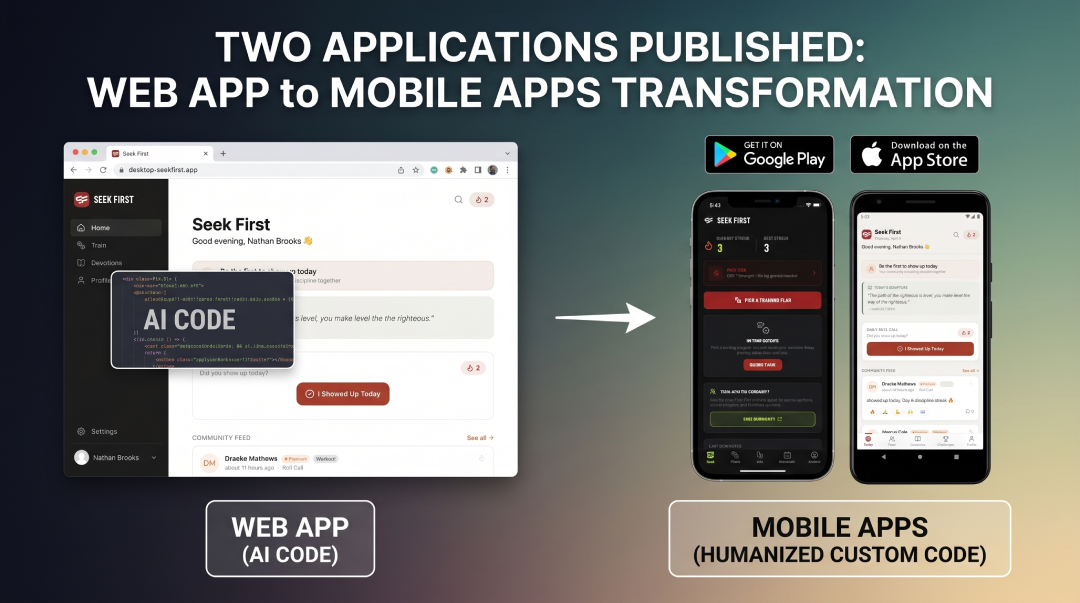
SeekFirst is more than a fitness app; it’s a lifestyle platform. The challenge was to build a community-driven app where users could post daily activities, find fitness tips, and build discipline through shared experiences.
The Steigern Tech Solution
We utilized a Full-Stack Flutter and Node.js approach to deliver a premium mobile experience:
-
Social Integration: Building a custom social feed where users can share their progress and experiences in real-time.
-
Gamified Discipline Tracking: Engineering a robust habit-tracking engine that rewards consistency and community engagement.
-
High-Engagement UX: Designing a realistic, high-fidelity interface that motivates users to return daily.
The Result
Steigern Tech delivered an end-to-end ecosystem that connects people across the globe, proving that “vibe” (the feeling of community) is best supported by “structure” (the discipline of code).
Methodology to fix the vibe code using the manual code approach
How we help clients move from “vibe” to “vessel.”
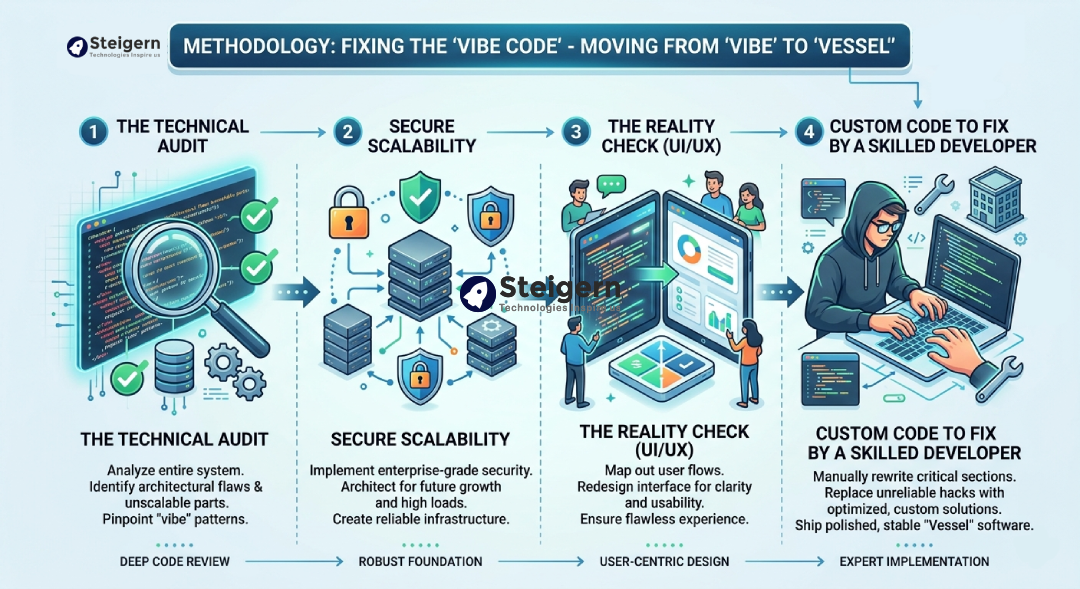
Phase 1: The Technical Audit
We don’t just write code; we analyze the existing “vibe.” We identify where the AI-generated logic is weak and where the architecture needs reinforcement.
Phase 2: Secure Scalability
We implement industry-standard security protocols from OAuth2 to AES-256 encryption ensuring your client data is never a liability.
Phase 3: The Reality Check (UI/UX)
We replace generic, AI-looking assets with high-fidelity, realistic human depictions and original branding. We ensure your product looks as professional as it performs.
Phase 4: Custom code to fix by skilled developer
there is a common trajectory: a founder has a “vibe,” uses an AI tool to generate a beautiful landing page, and hosts it instantly on a platform like Netlify or Horizon. For a week, it’s perfect. But then comes the need for real power user accounts that persist, complex data relationships, and a backend that doesn’t just “act” like an app but is one.
This is the transition from Vibe Coding to Professional Engineering. If your project has outgrown its static roots, it’s time for the “Vibe Code Fix”: migrating to a robust Node.js API, a serverless Neon PostgreSQL database, and hosting it all on Render.com
Why Move Beyond Static Hosting?
Platforms like Netlify and Horizon are incredible for static sites. However, if your business requires high-performance data processing or custom server-side logic, you will eventually hit the “Static Wall”:
-
Database Limitations: Simple local storage or “vibe-based” databases can’t handle complex relations or massive scale.
-
Serverless Cold Starts: While “Functions” work, a dedicated Node.js API on Render provides lower latency for constant traffic.
-
State Management: Real apps need to remember users, their history, and their preferences across sessions without fail.
The Power Stack: Node.js + Render + Neon DB
To fix a “vibe” and turn it into a vessel, we recommend a stack that balances developer speed with enterprise-grade reliability.
1. The Engine: Node.js & Express
Node.js allows you to build a fast, non-blocking API. Unlike static sites, this “engine” stays running, ready to process payments, send notifications, and handle logic that shouldn’t be exposed on the frontend.
2. The Memory: Neon DB (PostgreSQL)
Neon is the world’s first serverless Postgres. It separates compute from storage, meaning your database can “scale to zero” when not in use (saving money) but scale instantly to handle thousands of users.
Expert Tip: Neon’s “branching” feature allows you to create a copy of your database in seconds to test new features without breaking your live site.
3. The Home: Render.com
Render is the modern successor to Heroku. It provides a unified cloud platform where your Node.js API and your frontend live together. Its private networking ensures your database and API communicate at lightning speed.
Why Hire Steigern Tech for fix vibe coding fix?
-
Full-Stack Expertise: We don’t just “fix” code; we architect systems in React, Node.js, and Flutter.
-
Global Reliability: Trusted by clients in Switzerland, Italy, Australia, India, and beyond.
-
AI Integration: We are specialists in bridging the gap between AI prompts and production-ready APIs.
-
Performance First: We optimize your hosting on Render and Neon to ensure your costs stay low while your speed stays high.
If you have a project that has outgrown its “vibe,” or if you’re looking to start a new venture with the right architectural foundation, Steigern Tech LLP is here to bridge the gap.
Stop coding in the dark. Let’s build something enduring together.
Connect with Steigern Tech LLP – Where Professional Engineering Meets Visionary Intent.